Choosing a Tongkat Ali supplement is harder than comparing the biggest extract ratio or the boldest promise. Product quality depends on the correct plant, the part used, how the extract was made, what the label discloses, and whether the finished batch has been tested. This practical guide explains the checks that matter and the claims that deserve caution.
Quick answer: Look for the botanical name Eurycoma longifolia, root as the plant part, a clear amount per serving, manufacturer and batch details, realistic claims, and evidence that the finished product was tested. An impressive “100:1” or “200:1” ratio alone does not prove purity, strength or safety.
What is Tongkat Ali?
Tongkat Ali is the common Malay name most often used for Eurycoma longifolia, a plant native to Southeast Asia. Its roots have a history of traditional use, and modern studies have investigated specific extracts for areas such as stress, testosterone and male sexual health. However, the evidence is still limited by small studies, different extract preparations and short follow-up periods. It does not establish that every product sold as Tongkat Ali will have the same composition or effect.
A 2015 systematic review of randomized trials found that more efficacy studies were needed, while a later meta-analysis described a possible effect on total testosterone but also stated that more research was required before clinical use. One 24-week trial of a combined Tongkat Ali extract and multivitamin found no significant between-group differences for its main outcomes. These mixed findings are a good reason to avoid guaranteed results or disease-treatment claims.
Seven checks before buying Tongkat Ali
1. Confirm the botanical name and plant part
The label should identify the plant as Eurycoma longifolia and specify the root. “Tongkat Ali” by itself is not precise enough because similar common names can be applied to different plants. A seller should not present so-called yellow, black and red Tongkat Ali as interchangeable grades of one botanical. If a product contains more than one species, each botanical name and amount should be declared separately.
2. Check the actual amount per serving
Find the quantity of powder or extract in milligrams for the stated serving. Avoid proprietary blends that hide individual amounts. The number of capsules on the front of a bottle tells you nothing about the amount in each serving.
3. Do not confuse an extract ratio with standardization
An extract ratio such as 100:1 describes a manufacturing relationship claimed between raw material and extract. It is not a universal potency scale and does not, by itself, confirm the level of any active compound. Standardization is different: it means the manufacturer aims for a stated level or range of a marker compound, sometimes eurycomanone. If a marker percentage is claimed, ask how it was measured and whether the result applies to the batch being sold.
4. Ask for batch-specific testing
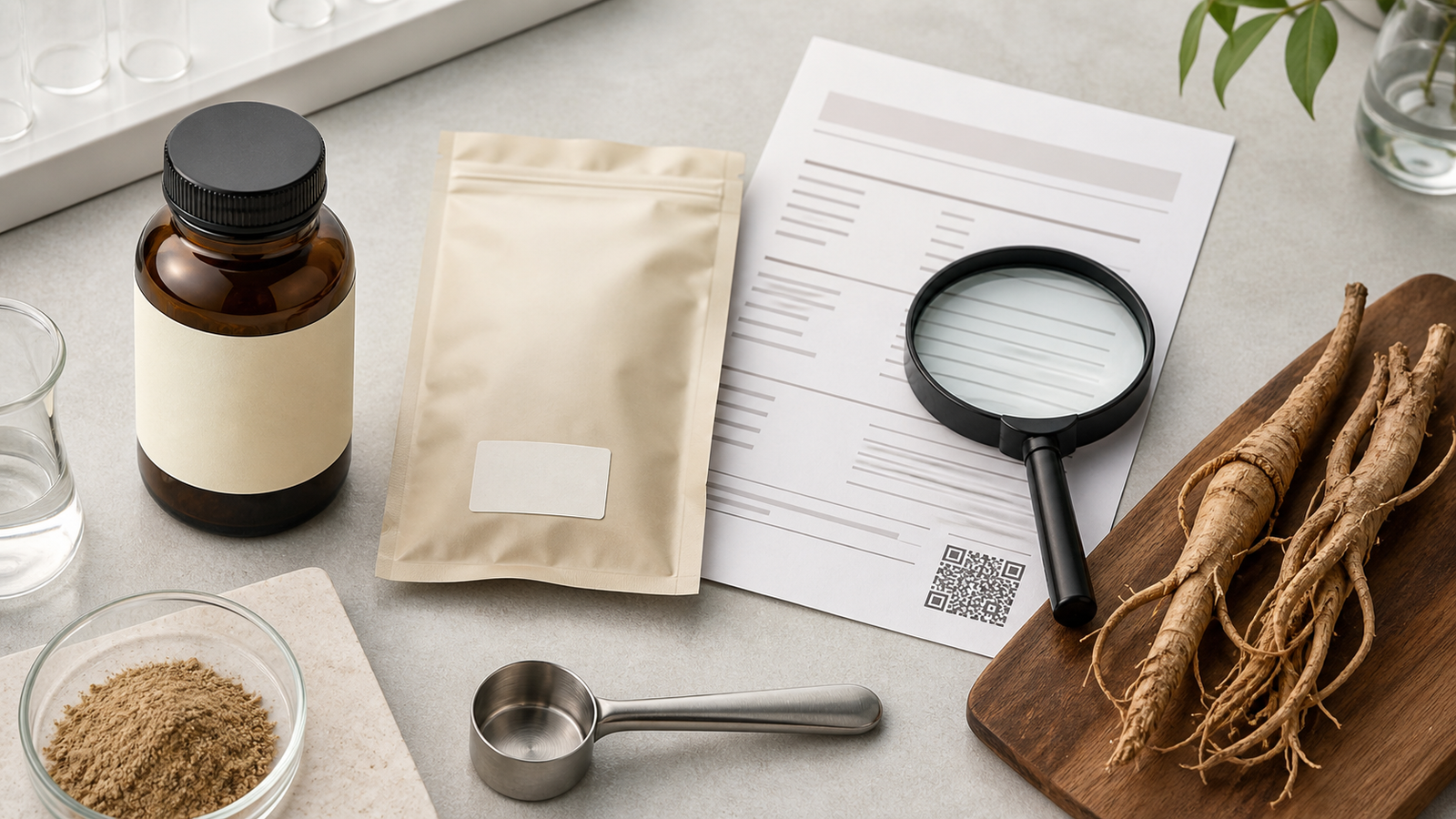
A useful certificate of analysis should match the product name or code and the batch or lot number on the package. Depending on the product and market, relevant checks may include identity, marker compounds, microbial limits and contaminants such as lead, mercury, arsenic and cadmium. A generic certificate copied from a supplier, an undated screenshot or a document for a different batch is weak evidence.
5. Verify the manufacturer and local regulatory status
The package should show a responsible manufacturer or distributor, contact details, lot number, expiry date, storage instructions and directions for use. In Malaysia, do not rely only on a logo or the words “KKM approved.” Search the product name or registration number in the official NPRA QUEST3+ product-search system and make sure the name, holder and status match the item offered. Registration status can change, so check at the time of purchase.
6. Treat GMP and “lab tested” as claims to verify
Good Manufacturing Practice concerns manufacturing controls; it does not prove that a supplement will deliver a promised health outcome. Similarly, “lab tested” is incomplete unless the seller identifies what was tested, by whom, using which method and for which batch.
7. Prefer realistic, specific communication
Red flags include claims of instant effects, guaranteed testosterone increases, treatment of erectile dysfunction, “zero side effects,” or the same result for every user. A responsible seller explains what the product contains, acknowledges the limits of current evidence and does not replace medical assessment with a supplement.
What does the research actually mean?
Clinical research usually evaluates one defined extract at a specific dose in a selected group of participants. Results cannot automatically be transferred to every root powder, mixed formula or concentrated extract. Study doses also do not create a universal dose for all adults.
Safety conclusions can differ by preparation and regulator. For example, the European Food Safety Authority assessed one proposed standardized water extract as a novel food and concluded that its safety had not been established under the proposed conditions because of a genotoxicity concern. That opinion does not prove that every Tongkat Ali product has the same risk, but it demonstrates why extract identity and long-term safety should not be assumed.
If you decide to use a supplement, follow the product label and discuss it with a qualified healthcare professional when your health, medicines or goals make the decision more complex. There is no established evidence-based rule that everyone should use a “five days on, two days off” cycle.
Who should seek medical advice first?
- Anyone who is pregnant or breastfeeding, and children or adolescents.
- People with liver, kidney, heart, prostate, endocrine or hormone-sensitive conditions.
- Anyone taking prescription medicines, hormone therapy or several supplements.
- People being evaluated for infertility, low testosterone, persistent fatigue or sexual symptoms.
Stop using the product and seek professional advice if you develop a concerning reaction. A supplement should not delay diagnosis or replace prescribed treatment.
A quick buying checklist
- Botanical name: Eurycoma longifolia.
- Plant part: root.
- Amount per serving clearly stated.
- Extract ratio and marker standardization described separately.
- Batch, expiry, manufacturer and distributor details present.
- Batch-matched identity and contaminant documentation available.
- Malaysian registration checked directly in NPRA QUEST3+ when applicable.
- No instant, guaranteed or disease-treatment promises.
Frequently asked questions
Is the highest extract ratio always the best?
No. Ratios are not directly comparable without information about the starting material, extraction method, yield and final composition. Verify the finished product rather than choosing by the largest number.
Does eurycomanone percentage prove overall quality?
It can be one useful marker when accurately tested, but it does not replace botanical identification, contaminant screening, manufacturing controls or a complete label.
How long should Tongkat Ali take to work?
There is no reliable timetable that applies to every person or product. Claims promising a specific effect in minutes or a guaranteed result within days should be treated cautiously.
Can women use Tongkat Ali?
Research in women is limited, and there is no universal evidence-based women’s dose. A clinician can help assess pregnancy risk, hormone-sensitive conditions, medicines and the reason for use.
Can it be combined with Korean Red Ginseng?
The combination should not be assumed to be more effective or safer simply because both ingredients are traditional herbs. Mixed products make it harder to identify effects and interactions. Ask a healthcare professional if you use medicines or have a health condition.
Compare product information carefully
Our English Tongkat Ali collection lets you review the available product details. Use the checklist above, verify any registration or test claim independently, and ask us for missing information before purchasing.
Sources and further reading
- Systematic review of randomized trials on erectile function (2015)
- Systematic review and meta-analysis on total testosterone (2022)
- Randomized placebo-controlled study of Tongkat Ali extract with multivitamins (2018)
- EFSA safety assessment of one Tongkat Ali root extract (2021)
- Malaysia NPRA QUEST3+ information and product search
Reviewed by Healthy Max Team. This article is for general education and is not medical advice.